
An incident response plan (IRP) is a documented, step‑by‑step playbook that tells your team exactly how to detect, triage, contain, eradicate, recover from, and learn from security and service incidents. It turnsAn incident response plan (IRP) is a documented, step‑by‑step playbook that tells your team exactly how to detect, triage, contain, eradicate, recover from, and learn from security and service incidents. It turns a chaotic situation into a controlled, repeatable process that minimizes damage and downtime.
What an Incident Response Plan Is
An incident response plan (IRP) is a documented, step‑by‑step playbook that tells your team exactly how to detect, triage, contain, eradicate, recover from, and learn from security and service incidents. It turns a chaotic situation into a controlled, repeatable process that minimizes damage and downtime.
What an Incident Response Plan Is
An incident response plan is the central document your organization executes during a security or major service incident, defining what qualifies as an incident, how incidents are classified, who is responsible for what, and how you communicate internally and externally. It typically includes:
Incident response policy and scope

Roles and responsibilities (incident commander, technical responders, communications, legal,An incident response plan (IRP) is a documented, step‑by‑step playbook that tells your team exactly how to detect, triage, contain, eradicate, recover from, and learn from security and service incidents. It turns a chaotic situation into a controlled, repeatable process that minimizes damage and downtime.
Why You Need an Incident Response Plan
Without a defined IRP, teams often respond inconsistently, miss critical containment steps, or fail to notify the right stakeholders in time, increasing both technical and business impact. An IRP ensures you have a prepared, practiced approach that reduces mean time to detect (MTTD), mean time to respond (MTTR), and overall incident severity.
Key benefits include:
Faster, more coordinated response with clear roles, authority, and decision paths.

Reduced damage and downtime through predefined containment and recovery procedures.

Improved compliance and customer trust by demonstrating a mature, tested incident handling capability.
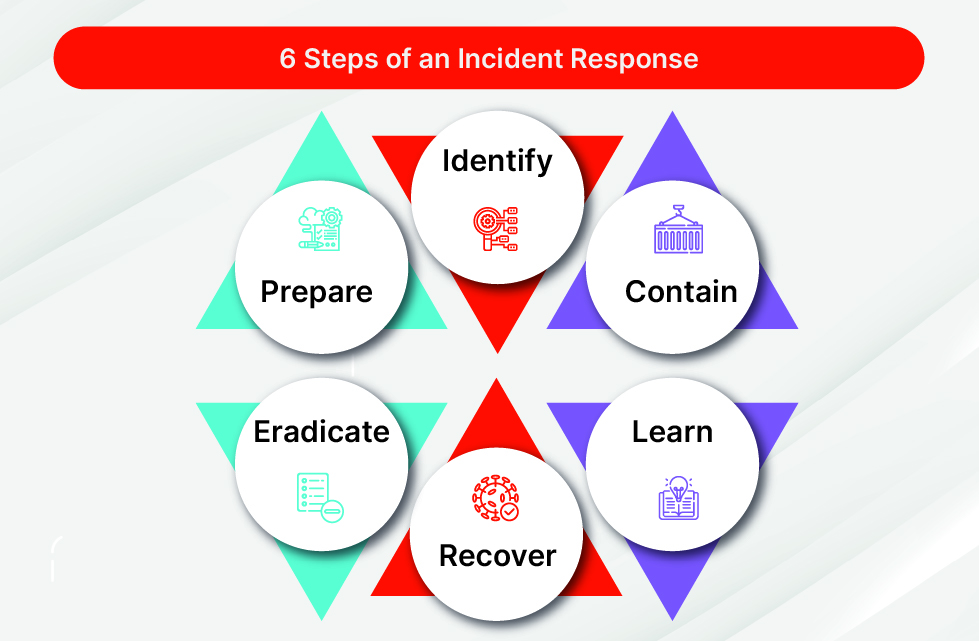
Typical Incident Response Lifecycle (Step‑by‑Step)
Use this as the backbone of your IRP, then layer in your specific tools and playbooks.
Preparation

Build your IRP, train your team, configure monitoring and alerting, and establish communication channels and escalation paths.

Detection and Identification

Detect suspicious activity via monitoring tools or reports, analyze alerts, confirm whether an incident has occurred, and assign an initial severity.

Containment

Take immediate actions to stop the threat from spreading or causing further damage (for example, isolate hosts, disable accounts, block IPs, segment networks).

Eradication

Remove the root cause and any remaining malicious components (malware, backdoors, compromised credentials) and address exploited vulnerabilities.

Recovery

Restore systems to normal operation, validate integrity, re‑enable services in a controlled manner, and monitor closely for signs of re‑infection or recurrence.

Post‑Incident Activity (Lessons Learned)

Conduct a post‑mortem, document lessons learned, update the IRP and related controls, and track action items to prevent or reduce future incidents.
How Debugging Bug LTD Can Help You Build and Use an Incident Response Plan
Debugging Bug LTD can help you design an IRP that matches your actual environment, risk profile, and regulatory obligations, then embed it into your operations so it’s used consistently under pressure.
We can support you by:
Running a risk and asset assessment to identify your most critical systems, data, and likely incident scenarios, then tailoring your IRP accordingly.

Defining your incident response team structure, roles, and escalation paths, including alternates and on‑call rotations.

Creating severity classification criteria and decision trees so your team can quickly assign the right level of response.

Writing scenario‑based playbooks (ransomware, data breach, compromised account, major outage) with concrete, step‑by‑step technical and communication actions.

Building communication templates and stakeholder notification workflows for internal teams, customers, regulators, and, where needed, law enforcement.

Designing and facilitating tabletop exercises and simulations to validate your IRP, train your team, and uncover gaps before a real incident.

Integrating your IRP with your disaster recovery plan and post‑mortem process so incidents flow smoothly into recovery and continuous improvement.
With Debugging Bug LTD’s help, your incident response plan becomes a practical, tested capability that reduces downtime, limits damage, and continuously improves your security and operational resilience.