
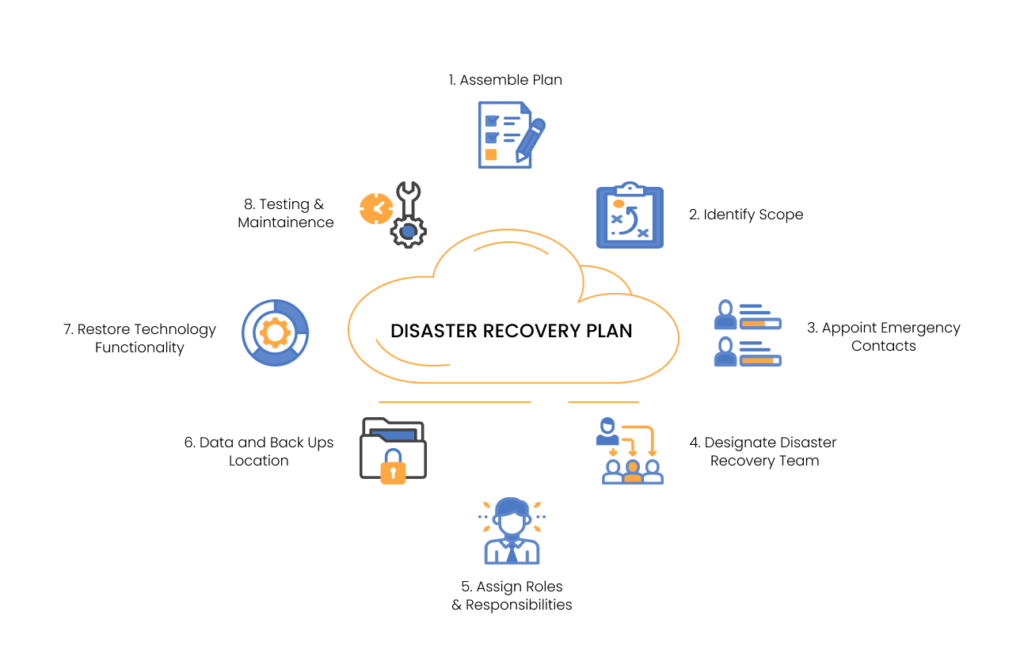
A disaster recovery plan (DRP) is a structured, documented approach that helps your business quickly restore critical systems, data, and operations after incidents such as ransomware, hardware failure, or major outages. Debugging Bug LTD can guide you through designing, implementing, and continuously improving this plan so it’s practical, testable, and aligned with your real-world infrastructure and risk profile.
What a Disaster Recovery Plan Is
A disaster recovery plan defines how your organization will respond to disruptive events, which systems and data must come back first, and who is responsible for each step in the recovery process. It focuses on restoring IT services and information assets so you can resume business operations within acceptable time and data-loss limits.
Key concepts include:
Recovery Time Objective (RTO): the maximum acceptable downtime for each system or service.

Recovery Point Objective (RPO): the maximum acceptable amount of data loss measured in time (for example, one hour or one day of data).

Recovery priorities: the order in which systems (identity, network, storage, core apps, edge apps) are restored based on business impact rather than noise.
Why Your Business Needs a DRP
A well-built DRP reduces downtime, limits financial and reputational damage, and ensures you can meet contractual, legal, and regulatory obligations after an incident. It also provides clarity and confidence during crises by documenting roles, communication channels, and step-by-step procedures, instead of relying on ad‑hoc decisions under pressure.
Benefits include:
Faster, more predictable recovery from events like ransomware, cloud outages, data corruption, or on‑prem hardware failures.

Clear accountability and governance through defined roles, escalation paths, and approval workflows.

Improved audit readiness and customer trust because you can demonstrate a tested recovery capability rather than a theoretical plan.
Core Components of a Strong DRP
A practical disaster recovery plan typically contains several core sections that you can adapt to your environment and risk profile.
Roles and responsibilities: who activates the plan, coordinates recovery, and executes tasks, including alternates.

Risk assessment and business impact analysis: prioritized threats, critical systems, and the financial/operational impact of downtime.

Recovery objectives: documented RTO and RPO per system or tier, aligned with business requirements.

Data backup and storage strategy: where backups live, how often they run, how they’re protected (encryption, access), and how they’re restored.

Disaster scenarios and playbooks: specific steps for top scenarios such as ransomware, regional data center loss, ISP outage, or data corruption.

Communication and escalation procedures: emergency contact lists, incident commander, notification templates, and communication channels (primary and backup).

Testing and training: tabletop exercises, simulations, and full-scale drills to validate the plan and improve it over time.

Maintenance and review cadence: scheduled updates tied to changes in applications, vendors, infrastructure, and staffing.
How Debugging Bug LTD Helps You Create the Plan
Debugging Bug LTD can act as your specialized partner to take this from theory to an actionable, tested plan tailored to your environment. Drawing on practical experience with complex, multi‑platform infrastructures, we help you avoid generic, one‑size‑fits‑all templates and instead build a plan rooted in your actual systems, risks, and constraints.
Our support typically includes:
Structured workshops to capture business objectives, risk appetite, and critical systems, turning them into clear RTO/RPO targets.

Detailed asset and dependency mapping across on‑prem, cloud, and hybrid environments so recovery sequences are realistic and achievable.

Design of backup, replication, and failover architectures that match your budget, compliance requirements, and performance needs.

Creation of scenario‑based runbooks for top risks (for example, ransomware playbook, data‑center failure, ISP outage, cloud region loss).

Development of communication plans and escalation workflows, including customer and regulator notification templates where needed.
How Debugging Bug LTD Helps You Use and Maintain the Plan
Writing the plan is only half the work; Debugging Bug LTD also helps you embed it into daily operations so it stays current and actually works during a crisis.
We can help you:
Run regular disaster recovery tests (tabletop and technical) and translate lessons into concrete improvements in technology, process, and documentation.

Integrate DRP updates with your change management process so new applications, sites, and vendors automatically trigger plan revisions.

Train your technical teams, leadership, and front‑line staff on their roles during incidents, using clear playbooks and practical exercises.

Monitor key metrics such as recovery time, data loss, and incident frequency to track DRP effectiveness and justify future investments.
With Debugging Bug LTD’s guidance, you end up with a disaster recovery plan that is simple enough to execute under stress, detailed enough for technical teams, and flexible enough to evolve as your business and infrastructure change.