
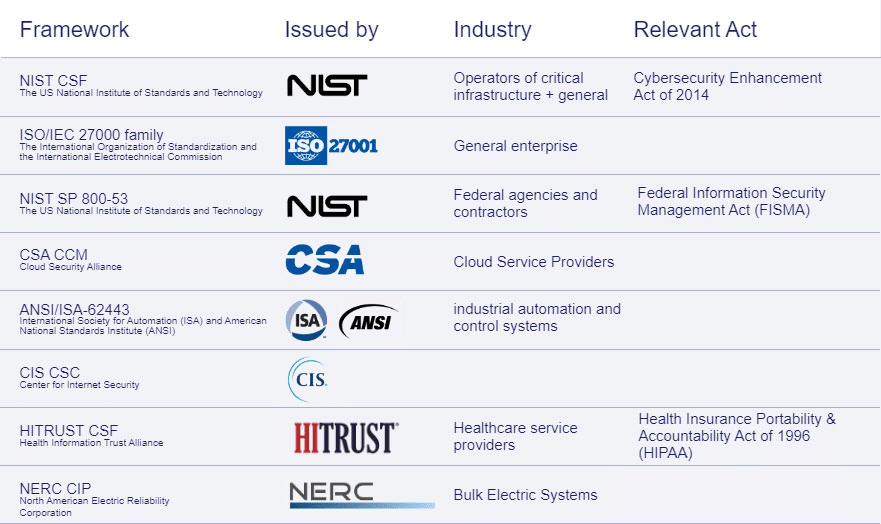
Cybersecurity frameworks are structured sets of standards, controls, and best practices that show “what good looks like” for managing cyber risk in a consistent, auditable way. Debugging Bug LTD can help organizations choose the right framework, map it to their business, and turn it into day‑to‑day practices instead of just paperwork.
What Cybersecurity Frameworks Are
A cybersecurity framework is a documented blueprint of policies, processes, and technical controls designed to help organizations identify, protect, detect, respond to, and recover from cyber threats. Frameworks provide a common language for security, so stakeholders can align on risk, priorities, and responsibilities across the organization.
Common examples include:
NIST Cybersecurity Framework (CSF) and NIST SP 800‑53/800‑171 for broader risk management and federal/defense environments.

ISO/IEC 27001 for information security management systems with formal certification.

CIS Controls, SOC 2, PCI DSS, HIPAA Security Rule, and CMMC for specific industries, audit requirements, or attestation standards.
Why Organizations Use Cybersecurity Frameworks
Organizations adopt frameworks to manage complex and evolving cyber risks through a structured, repeatable approach rather than ad‑hoc controls. Frameworks also help satisfy regulatory requirements, meet client expectations, and demonstrate security maturity to auditors, customers, and boards.
Key benefits:
Risk‑based prioritization of security investments and controls instead of reactive spending.

Consistent policies and procedures across teams, locations, and technologies.

Easier audits, certifications, and third‑party assessments because controls map directly to recognized standards.

Continuous improvement through maturity tiers, profiles, and periodic gap assessments.
How Frameworks Are Structured (NIST CSF Example)
Many frameworks follow a lifecycle model that organizes security activities into functions and categories. The NIST Cybersecurity Framework (including CSF 2.0) is a widely used example.
Key components:
Framework Core: high‑level functions, categories, and subcategories that describe desired security outcomes.

Implementation Tiers: maturity levels that show how formalized and consistent your practices are (from partial to adaptive).

Profiles: customized views of the Core for a specific organization or system (current profile vs. target profile).
CSF’s core functions (now often six) form a continuous cycle:
Identify: understand assets, systems, data, and risks.

Protect: implement safeguards (access control, encryption, policies).

Detect: monitor and identify potential incidents.

Respond: contain and communicate during incidents.

Recover: restore operations and improve resilience.

Govern (CSF 2.0): formalize policies, accountability, and oversight.
How Debugging Bug LTD Helps Organizations Adjust to Frameworks
Debugging Bug LTD can guide organizations through the full journey—from initial framework selection to day‑to‑day operation—making frameworks practical, sustainable, and aligned with business reality rather than theoretical checklists.
- Framework Selection and Strategy
We help you:
Clarify your business drivers (regulatory, client demands, risk reduction, certification) and define what “success” looks like.

Choose a primary framework (for example, NIST CSF, ISO 27001, CIS Controls) and map any necessary cross‑walks to sector‑specific standards (PCI DSS, HIPAA, SOC 2, CMMC).

Align framework adoption with your broader security, compliance, and IT roadmaps, avoiding conflicting priorities and duplicated effort.- Gap Assessment and Current Profile
Using the chosen framework, Debugging Bug LTD can:
Conduct a structured gap analysis to compare your current controls against framework requirements and best practices.

Build a “current profile” that shows where you are today in terms of maturity, mapped to functions, categories, and subcategories.

Identify quick wins and high‑risk gaps so you can prioritize remediation intelligently.- Target Profile and Roadmap
We work with stakeholders to:
Define a realistic “target profile” that fits your size, budget, risk appetite, and regulatory expectations.

Build a phased roadmap that starts with foundational controls (asset inventory, access management, patching, logging, backups) and then moves to advanced capabilities.

Sequence projects to avoid burnout and ensure visible early value, using milestones and metrics to prove progress.- Translating Frameworks into Real Controls
Debugging Bug LTD focuses on implementation details, such as:
Turning framework statements (for example, “manage identities and access”) into concrete policies, role‑based access models, approval workflows, and technical enforcement in your directory and IAM tools.

Mapping “detect” and “respond” requirements into SIEM rules, alerting processes, incident response runbooks, and escalation matrices.

Designing configuration baselines, hardening standards, and patch management processes aligned with controls from NIST, CIS, or ISO.- Embedding Frameworks into Operations
We help organizations avoid the “binder on a shelf” problem by:
Integrating framework requirements into existing processes like change management, procurement, project governance, and vendor risk management.

Setting up regular governance routines (for example, security steering committees, risk reviews) that reflect CSF’s “govern” function and other oversight requirements.

Defining metrics and dashboards that show control effectiveness, risk trends, and compliance status to both technical and business stakeholders.- Training, Culture, and Continuous Improvement
Finally, Debugging Bug LTD supports long‑term adoption by:
Delivering framework‑aligned training and awareness programs tailored to different roles (end users, admins, developers, managers).

Running workshops and tabletop exercises to test controls and incident processes against framework expectations.

Periodically reviewing your framework implementation, updating profiles and roadmaps as your organization grows, adopts new technologies, or faces new regulations.
By combining recognized cybersecurity frameworks with practical implementation support, Debugging Bug LTD helps organizations move from confusion to a clear, risk‑based security program that is auditable, defensible, and adaptable over time